
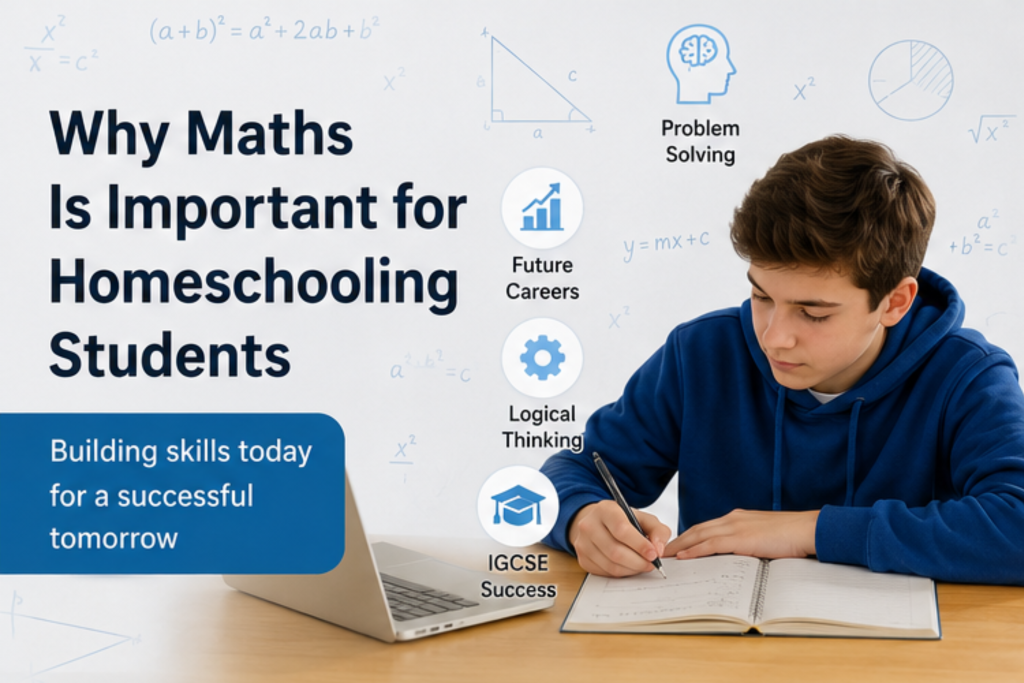
Why Is Maths Important, Especially for Homeschooling Students?
In This Article
- ARTICLE
- July 9, 2026
- 2:21 pm
Imagine waking up tomorrow to discover that maths no longer exists.
Your bank account could no longer calculate your balance. Your sat-nav would not know the quickest route home. Online shopping websites would not know what to charge you, and your smartphone would struggle to perform even its simplest functions. Modern medicine, engineering, banking, and even artificial intelligence all depend on mathematics.
Yet despite living in a world built upon numbers, maths is often regarded as one of the most challenging subjects students study. It is also one of the subjects most likely to be questioned.
“Why do I need to learn this if I have a calculator?”
“Won’t artificial intelligence just do it for me?”
For homeschooling families, these questions are even more common. With the freedom to choose how and what a child studies, parents naturally want to focus on subjects that actually prepare their children for life. When maths becomes difficult, it can be tempting to wonder whether the time invested is worthwhile.
The answer is a clear yes.
Maths is far more than a collection of formulas and calculations. It teaches students how to think logically, solve problems, make informed decisions, and understand the increasingly technological world around them. Whether your child hopes to become an engineer, a teacher, a software developer, a doctor, or simply a financially confident adult, mathematics provides skills that last a lifetime.
This post explores why maths is important for homeschooled students, how it supports future education and careers, and why studying IGCSE Maths for home-educated students in the UK continues to be one of the best investments a family can make.
AI Has Made Maths More Important, Not Less
One of the biggest misconceptions today is that calculators and artificial intelligence have made mathematics unnecessary.
On the surface, this seems reasonable. A calculator can solve arithmetic problems in seconds. AI tools can explain algebra, generate graphs, and even work through complex equations.
So why should students still spend years learning maths?
The answer lies in understanding what these technologies actually do.
Using AI is easy. Understanding AI is something entirely different.
Artificial intelligence is built upon mathematics. Machine learning models identify patterns, optimise enormous amounts of data, and make predictions using probability, statistics, and algebra. Behind every AI chatbot, recommendation system, or image generator sits mathematics working quietly in the background.
Students who study maths are not learning outdated skills. They are learning the language that powers one of the most influential technologies of the modern world.
Even if a student never works directly in artificial intelligence, understanding mathematical thinking allows them to use technology more intelligently. Rather than accepting every answer without question, they learn to evaluate information, recognise mistakes, and think critically about the results technology provides.
Ironically, the more advanced technology becomes, the more valuable mathematical thinking becomes.
Maths Is Everywhere In Everyday Life
Even outside technology, maths plays a much greater role in daily life than many people realise.
Every time you compare prices in a supermarket, work out whether a discount is genuinely a good deal, or calculate how much fuel will cost for a journey, you are using mathematics.
Managing household finances depends heavily on numeracy. Mortgages, savings accounts, interest rates, utility bills, investments, insurance policies, and monthly budgets all require an understanding of numbers. The ability to interpret these figures allows people to make informed financial decisions instead of relying entirely on someone else’s advice.
Home improvement projects also rely on maths. Measuring rooms before buying furniture, calculating the amount of paint needed for decorating, planning a garden, or estimating flooring materials all require practical mathematical skills.
Cooking provides another everyday example. Recipes often need ingredients to be doubled, halved, or converted between different units of measurement. Travelling requires calculations involving time, distance, speed, exchange rates, and budgeting.
Even hobbies frequently involve mathematics.
Sports use statistics to analyse player performance. Strategy games involve probability and decision-making. Music depends on rhythm and timing, while sewing, woodworking, and gardening all involve measurements and careful planning.
These examples demonstrate the importance of maths in daily life in the UK and beyond. Most people use mathematical thinking far more often than they realise.
Perhaps more importantly, maths teaches confidence.
Instead of feeling intimidated by numbers, students become comfortable analysing information, estimating answers, and making decisions based upon evidence. Those habits remain useful throughout education, employment, and everyday life.
Maths Teaches You How to Think
One of the greatest misconceptions about maths is that it is simply about finding the correct answer.
In reality, maths is about developing a way of thinking.
Every mathematical problem follows a process. First, you identify what the question is asking. Then you break the problem into smaller parts, understand the information you have been given, decide which method is most appropriate, and finally apply that method to reach a solution.
This may sound simple, but it mirrors the way we solve problems throughout life.
Whether you are planning a project at work, diagnosing a fault with your car, comparing mortgage options, writing computer code, or organising a family budget, the process is remarkably similar. You identify the problem, analyse the information available, consider possible solutions, and decide on the best course of action.
These problem-solving skills are one of the greatest benefits of studying maths. Rather than memorising facts, students learn how to think logically, recognise patterns, and approach unfamiliar situations with confidence.
This is one reason why employers consistently value mathematical ability. They are not simply looking for someone who can solve equations. They are looking for someone who can think critically and solve problems independently.
Why Calculators And AI Cannot Replace Mathematical Understanding
Some students believe calculators remove the need to learn maths altogether.
After all, if a calculator can perform calculations instantly, why spend time learning them?
The answer is that calculators only calculate. They do not think.
A calculator cannot decide which mathematical method should be used. It cannot interpret a worded problem or explain why one approach is better than another. It simply performs the calculation you ask it to perform.
This is one reason why Pearson Edexcel IGCSE Maths allows calculators in every examination paper. The qualification is not testing whether students can multiply large numbers quickly. It is testing whether they understand the mathematics well enough to know which methods should be applied.
Mathematical understanding also allows students to recognise when technology has produced an unrealistic answer.
Suppose you multiply 49 by 51 but accidentally enter the wrong numbers into your calculator and receive an answer of 100. A student with good number sense immediately knows something is wrong because they can estimate that the answer should be close to 2,500. Someone who relies entirely on technology may simply accept the incorrect result.
The same applies to artificial intelligence.
AI can produce impressive explanations, but it is not infallible. It occasionally misunderstands questions, makes calculation errors, or confidently presents incorrect information. Students who understand the underlying mathematics are far better equipped to recognise these mistakes.
Technology should support mathematical thinking, not replace it.
"Will I Ever Actually Use Circle Theorems?"
This type of question is probably one of the most common questions maths teachers hear.
Realistically, most adults are unlikely to use circle theorems, quadratic equations, or simultaneous equations in their daily lives.
So why are they taught?
The answer is that these topics are not simply about learning mathematical facts. They are exercises in logical thinking.
When students study circle theorems, they learn to identify patterns and recognise when specific rules apply. When solving quadratic equations, they learn to evaluate different methods before deciding which approach is most efficient.
Each new topic develops analytical thinking, logical reasoning, persistence, and the ability to tackle unfamiliar problems.
A useful comparison is going to the gym.
Very few people lift weights because they expect to spend their lives carrying dumbbells. They exercise because lifting weights develops strength that benefits countless other activities.
Advanced maths works in much the same way.
Students may not regularly use every mathematical technique they learn, but the process of mastering challenging concepts strengthens their ability to reason logically, solve problems, and think independently. That is why educators continue to encourage students to study maths beyond GCSE, even if they later pursue careers outside mathematics itself.
Maths Opens Doors To Future Opportunities
Mathematics also creates opportunities that would otherwise remain closed.
Many STEM careers in the UK require a strong mathematical foundation. Students hoping to study Computer Science, Engineering, Economics, Data Science, Physics, or Mathematics at university will often need A-Level Maths, making a good GCSE or IGCSE grade the first important step.
As artificial intelligence continues to transform industries around the world, mathematical knowledge is becoming increasingly valuable. AI systems are built upon statistics, algebra, probability, and optimisation. Students who understand these concepts are better prepared for one of the fastest-growing sectors of the global economy.
Even outside STEM careers, numeracy remains highly valued.
Accountants, electricians, architects, surveyors, financial advisers, software developers, healthcare professionals, and business owners all rely on mathematical thinking in different ways. Employers consistently look for applicants who can analyse information, interpret data, and solve problems confidently.
For many students, maths is far more than another GCSE subject. It is a qualification that provides access to future study, expands career choices, and develops skills that remain valuable regardless of the profession they eventually choose.
What If My Child Finds Maths Difficult?
There is no denying that maths can be a challenging subject. Every student develops at a different pace, and it is perfectly normal for some to find mathematical concepts more difficult than others.
If your child struggles with maths, it is important to remember that success does not always mean achieving the highest possible grade. Every student can benefit from the logical thinking, perseverance, and problem-solving skills that maths develops.
One advantage of the GCSE and IGCSE system is that maths is offered at two different tiers: Foundation and Higher.
Students who find maths particularly challenging can choose the Foundation tier, which focuses on the essential mathematical knowledge needed for everyday life and future study. While the highest available grade is a Grade 5, this still represents a strong achievement for many students and provides a recognised qualification accepted by colleges, employers, and many further education pathways.
The important thing is that students study at the level that best matches their current ability while continuing to build confidence in the subject.
An Additional Benefit of Homeschooling
One of the greatest advantages of home education is flexibility.
Unlike traditional schools, where entire year groups generally sit examinations together, homeschooling families have much greater freedom to decide when their child is ready.
A common question parents ask is whether homeschooled children can take IGCSE exams. The answer is yes. Home-educated students can enter examinations as private candidates through approved examination centres across the UK.
This flexibility creates opportunities that are difficult to achieve in a traditional classroom.
Students who need additional time can delay sitting an examination until they feel fully prepared. Equally, students who progress more quickly can choose to complete GCSE or IGCSE Maths earlier than the typical age of 15 or 16.
Many families choose this approach because it allows students to complete subjects as they become ready rather than according to an arbitrary timetable. Completing maths early can also create more time to focus on demanding GCSE subjects later or even begin studying A-Level content sooner.
Every student’s educational journey is different, and one of the greatest strengths of home education is the ability to tailor that journey to the individual rather than the average.
Learning Maths With EdEx Online
Teaching maths at home can sometimes feel daunting, particularly as topics become more advanced. Many parents worry about whether they are following the correct order, covering everything required by the specification, or preparing their child effectively for the final examination.
That is where structured online learning can make a real difference.
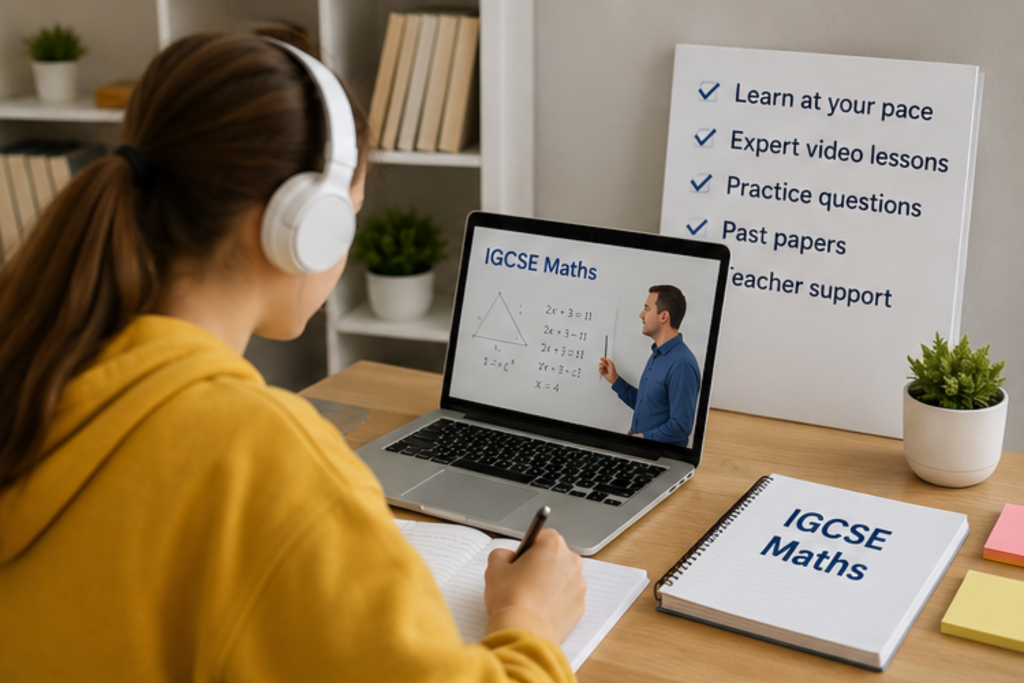
At EdEx Online, we provide online IGCSE courses for homeschooling that remove the uncertainty from planning your child’s maths education. Rather than trying to piece together resources from multiple websites or textbooks, students follow a carefully structured course designed to cover the complete Pearson Edexcel IGCSE Maths specification.
Our online IGCSE Maths course gives homeschooling families the flexibility to study whenever it suits their schedule while still benefiting from expert teaching and ongoing support. Students can pause lessons, revisit difficult topics, and progress more quickly through areas they already understand, allowing learning to happen at a pace that suits the individual.
Just as importantly, students receive guidance from experienced teachers and regular opportunities to practise using IGCSE Edexcel Maths past papers. Receiving feedback on exam-style questions helps students improve their mathematical understanding, strengthen their exam technique, and build confidence long before they sit the real examination.
For many homeschooling families, this combination of flexibility, structure, and expert support provides the ideal balance between independent learning and professional teaching.
Final Thoughts
Mathematics is not simply learning useless concepts to get by with school.
It teaches students how to analyse problems, think logically, make informed decisions, and approach unfamiliar situations with confidence. These are skills that remain valuable regardless of whether someone becomes a doctor, an engineer, a business owner, a software developer, or chooses an entirely different career path.
Far from making maths less important, modern technology has made mathematical thinking more valuable than ever. Calculators can perform calculations, and artificial intelligence can generate answers, but neither can replace a genuine understanding of mathematical concepts or the ability to think critically.
For homeschooling families, studying maths also offers the flexibility to learn at the right pace, sit examinations when students are ready, and build a strong academic foundation for whatever comes next.
Whether your child dreams of pursuing STEM subjects, preparing for university, or simply gaining the confidence to tackle everyday challenges, investing time in maths is an investment that will continue to pay dividends throughout their education and beyond.