
A Complete Guide to Pearson Edexcel International GCSE Maths Course (4MA1)
In This Article
- ARTICLE
- June 22, 2026
- 8:36 am
For many students, Mathematics is the subject that creates the most uncertainty. Some enjoy the challenge of solving problems, while others worry that they are simply “not a maths person”. Yet regardless of future career plans, Mathematics remains one of the most important qualifications a student can achieve.
Whether your child is studying in school, learning online, or being homeschooled, Pearson Edexcel International GCSE Mathematics (4MA1) provides a recognised pathway that develops both mathematical knowledge and problem-solving skills. In this guide, we will explain what the qualification involves, what students learn, how the exams work, and why it continues to be one of the most popular IGCSE subjects worldwide.
What Is Pearson Edexcel International GCSE Maths (4MA1)?
Pearson Edexcel International GCSE Mathematics (Specification A), commonly known as 4MA1, is an internationally recognised mathematics qualification designed for students aged 14 to 16.
The course develops mathematical fluency, logical thinking, reasoning, and problem-solving skills. Students learn how to apply mathematics in both academic and real-world situations, building skills that support future study and everyday life.
The qualification is recognised by schools, colleges, universities, and employers around the world, making it a popular choice for both traditional school students and homeschooling families.
Flexible Learning for Modern Students
Mathematics is one of the few subjects that remains relevant regardless of a student’s future plans.
Strong mathematical skills support success in subjects such as Physics, Computer Science, Economics, Business Studies, and Engineering. Many university courses also require students to hold a good Mathematics qualification before admission can be considered.
Beyond academics, Mathematics teaches students how to think logically, analyse information, identify patterns, and solve problems systematically. These skills are useful in everyday decision-making and highly valued by employers across many industries.
Foundation and Higher Tier: Understanding the Difference
One of the most common questions parents ask is whether their child should study Foundation or Higher Tier Mathematics.
Foundation Tier
The Foundation Tier is designed for students working towards grades 1 to 5. It focuses on building strong mathematical foundations and confidence while covering the core skills needed for progression.
Higher Tier
The Higher Tier is designed for students aiming for grades 4 to 9. Students study all of the Foundation content alongside more advanced topics and more challenging problem-solving questions.
Many students begin their studies with a provisional tier in mind, but teachers often review progress throughout the course before making final examination recommendations.
How Is International GCSE Maths Assessed?
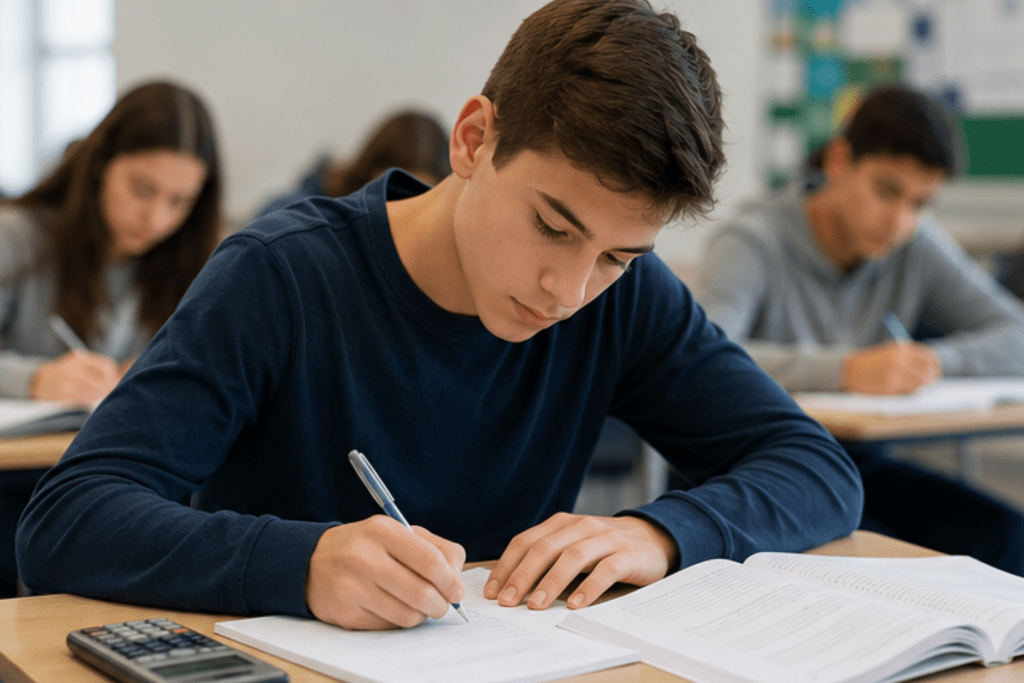
Unlike some subjects, International GCSE Mathematics is assessed entirely through final examinations.
Students sit two examination papers, with each paper contributing 50% of the overall grade.
Both examinations assess knowledge from across the syllabus rather than focusing on specific units. This means students need a strong understanding of all major topic areas and should regularly revisit earlier content throughout their studies.
Calculators are permitted in both examinations, and formula sheets are provided to students.
See How a Maths Past Paper Is Solved
One of the biggest challenges in Mathematics is not learning a method, but knowing when and how to apply it in an examination.
Many students understand topics during lessons but struggle when faced with unfamiliar exam questions. This is why guided past paper practice forms such an important part of successful revision.
In the video below, one of our teachers works through a real examination paper, explaining the thought process behind each solution, highlighting common mistakes, and demonstrating the techniques examiners expect to see.
Watching experienced teachers solve examination questions helps students develop confidence, improve exam technique, and understand how marks are awarded.
What Topics Will Students Study?
The course covers a broad range of mathematical content designed to develop both technical skills and problem-solving ability.
Number
Students learn to work confidently with:
- Fractions, decimals and percentages
- Ratio and proportion
- Standard form
- Powers and roots
- Compound interest
- Financial mathematics
- Accuracy and estimation
Algebra
Algebra is one of the largest areas of the course and includes:
- Expressions and formulae
- Expanding and factorising
- Solving equations
- Simultaneous equations
- Quadratic equations
- Graphs and functions
- Sequences
Geometry and Trigonometry
Students develop understanding of:
- Angles and polygons
- Transformations
- Constructions
- Bearings
- Pythagoras’ Theorem
- Trigonometry
- Mensuration
- Similarity and scale drawings
Statistics and Probability
This area focuses on:
- Collecting and interpreting data
- Averages and spread
- Statistical diagrams
- Probability calculations
- Tree diagrams
- Data analysis
Is International GCSE Maths Difficult?
The answer depends largely on preparation and consistency.
Many students find Mathematics challenging because new topics often build upon earlier knowledge. If gaps develop, later topics can feel much harder than they actually are.
The good news is that success in Mathematics is rarely about natural talent alone. Students who practise regularly, review mistakes carefully, and seek support when needed often make excellent progress.
Building confidence step by step is usually far more effective than trying to memorise large amounts of content shortly before the examinations.
How Many Hours Should Students Study?
Most students benefit from approximately 120 to 150 guided learning hours throughout the course.
This includes:
- Learning new topics
- Completing practice exercises
- Reviewing difficult concepts
- Working through exam-style questions
- Sitting past papers and mock examinations
Regular study sessions throughout the year are generally more effective than intensive revision shortly before exams.
Why Is International GCSE Maths Popular With Homeschooling Families?
Many homeschooling families choose International GCSE Mathematics because it offers a clear syllabus, internationally recognised qualification, and flexible learning pathway.
Students can study from anywhere in the world while following a structured curriculum that prepares them for further education.
The qualification also fits naturally alongside online learning programmes, giving students access to recorded lessons, live support, past paper practice, and teacher guidance throughout their studies.
What Can Students Do After International GCSE Maths?
A strong Mathematics qualification opens many future opportunities.
Students often progress to:
- A Level Mathematics
- Further Mathematics
- Physics
- Economics
- Computer Science
- Engineering
- Business-related courses
Even students who do not continue studying Mathematics directly will find that many university courses and employers expect applicants to have achieved a good Maths qualification.
Frequently Asked Questions (FAQ)
Yes. The qualification is recognised by schools, colleges, universities, and employers around the world.
Foundation Tier offers grades 1 to 5, while Higher Tier offers grades 4 to 9.
No. The qualification is assessed entirely through written examinations.
Yes. Many students successfully complete the qualification through online schools and homeschooling programmes.
Past papers are one of the most effective revision tools available. They help students become familiar with exam questions, improve timing, and strengthen exam technique.
Final Thoughts
Pearson Edexcel International GCSE Mathematics (4MA1) remains one of the most valuable qualifications a student can achieve. Beyond examination grades, it develops logical thinking, problem-solving ability, and confidence in handling numerical information.
Whether your child is studying in a traditional classroom, learning online, or following a homeschooling pathway, a strong foundation in Mathematics can support future academic success and open doors to a wide range of opportunities.