
GCSE vs IGCSE: What is the Difference
In This Article
- ARTICLE
- October 21, 2025
- 11:25 am
Introduction
The General Certificate of Secondary Education (GCSE) is an academic qualification usually taken at age sixteen. It marks the end of compulsory secondary education in England, Wales, and Northern Ireland. Assessment includes written exams and, in some subjects, coursework.
A common question among students aged 14–16 is “Is GCSE harder than IGCSE?” or “Are IGCSE harder than GCSE?”. Many thinks one demands more effort than the other. At EdEx Online, we often hear these questions from learners preparing for their exams independently. In this guide, we explain the real differences and what matters most for private candidates, including how to register for exams and what costs to expect.
What is the GCSE?
GCSE stands for General Certificate of Secondary Education. It is the main qualification taken by students in UK schools.
State schools handle exam registration for their pupils, while GCSE as a private candidate means you must register independently through an approved exam centre.
Most schools focus on the English Baccalaureate (EBacc) subjects. The main UK exam boards are AQA, Pearson Edexcel, and OCR, with WJEC and CCEA operating mainly in Wales and Northern Ireland. These boards design, mark, and award GCSEs under Ofqual regulation.
Some GCSE subjects include coursework that counts toward the final grade, such as English, geography, business studies, and science practicals.
What the Research Shows

Reforms introduced in 2015 reduced coursework and modular exams. Students now sit final exams at the end of the course. Maths and Science papers have Foundation and Higher tiers: Foundation targets grade 1–5, and Higher covers grades 4–9.
The Department for Education (DfE) publishes performance data based on GCSE results to measure pupil progress and school outcomes.
What is the EBacc (English Baccalaureate)?
The EBacc is not a qualification but a school performance measure. It recognises students who achieve grade 5 or above in five core GCSE subjects:
- English language or literature
- Mathematics
- Two sciences
- A modern or ancient language
- A humanities subject (such as history or geography)
Studying EBacc subjects keeps future academic and university options open.
What is the IGCSE?
The International General Certificate of Secondary Education (IGCSE) is similar in level to GCSE but designed for international use.
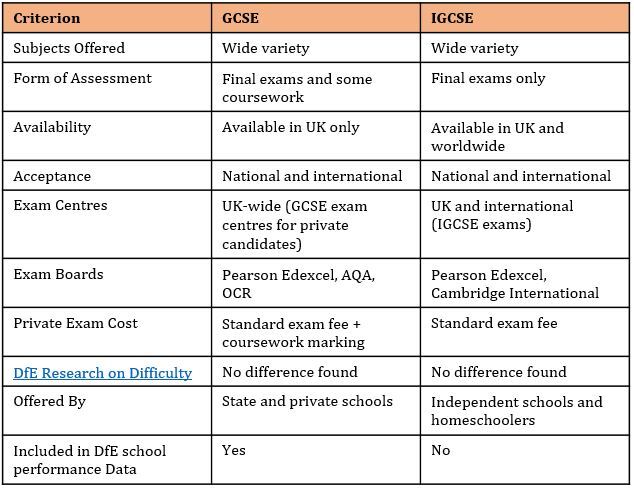
While once available in some UK schools, government funding for IGCSEs was withdrawn, so state schools now follow GCSEs. However, many independent and international schools continue to use International GCSEs because of their global recognition and flexible assessment style.
Two main awarding bodies offer IGCSEs used in the UK and abroad: Cambridge Assessment International Education and Pearson Edexcel International.
Subjects such as maths, English, sciences, geography, history, and business are widely offered. Most IGCSE exams are based only on final written assessments, with little or no coursework.
Although IGCSEs are not included in UK school performance tables, they are accepted by universities and employers worldwide.
Feedback from Private Candidates
Home-educated and private students often share similar experiences when choosing between GCSE and IGCSE:
- Coursework can add pressure for those studying independently.
- Some schools will not accept external GCSE candidates.
- The private exam cost varies by centre and subject.
- Preparation often requires paid tutors or online learning support.
- Different exam boards cover slightly different content, which can cause confusion.
- Foundation and Higher tiers influence results, especially in Maths and Science.
How to Request Flexischooling
Flexischooling and Online Schooling
Official research by the Department for Education found no clear difference in difficulty. Both qualifications test similar levels of understanding.
However, for private students or homeschoolers, IGCSEs may feel more straightforward because there is no coursework to manage. GCSEs, on the other hand, suit students who prefer teacher input and resources aligned with UK school standards.
Private GCSE Exam Centres and Costs
Private GCSE exam centres allow independent students to book and sit exams even if they are not enrolled in a school. You can find approved centres through exam board websites such as Pearson Edexcel or AQA.
The private GCSE exam cost varies depending on the subject and centre, usually ranging from £120 to £200 per subject. Some centres charge more for science practicals or coursework marking.
It is best to contact exam centres early, as places can fill up months before the exam session.
Conclusion
So, is IGCSE harder than GCSE, or is it the other way around? In truth, neither qualification is harder overall. The better choice depends on your goals, learning style, and how you plan to study.
For homeschoolers and independent learners, IGCSEs may offer simpler preparation through exam-only assessment. For those who want courses fully aligned with the UK system, GCSEs are often more suitable.
Whichever path you choose, plan early, understand your exam centre options, and select subjects that best fit your future plans.
Frequently Asked Questions (FAQ)
Yes. Both GCSE and IGCSE are equally accepted by UK colleges and universities. As long as subjects and grades meet entry requirements, there is no disadvantage in choosing IGCSE.
Yes. Private or home-educated students can study online through accredited platforms or with tutors. However, final exams must still be taken at approved exam centres.
It depends on your needs. IGCSEs are often preferred by home-educated students because they do not require coursework and have flexible assessment options. GCSEs may be better for those planning to return to mainstream school or who prefer courses aligned with UK state standards.
Exam fees vary by subject and centre but usually range between £120 and £200 per subject. Some centres charge extra for science practicals or coursework marking.
Research by the Department for Education found no clear difference in difficulty between GCSE and International GCSE. Both qualifications assess similar levels of knowledge and skill.